
How to Find Who Owns a Ontario County Property
Start with the street address. OnCor returns the matching parcel along with its owner field, mailing address, municipality, SBL, and deed reference. Confirm that name against the newest recorded deed. The annual roll can trail a recent closing by months, and an entity or estate owner on the deed may call for a business or probate cross-check.
- Search the address in OnCor and verify municipality and SBL.
- Read CURRENT OWNERS NAME and the separate mailing fields.
- Confirm the latest grantee and vesting language in the County Clerk index and deed.
- Check New York entity records or Surrogate's Court when an LLC, trust, or estate appears.
Where Ontario County Owner Information Comes From
Every owner answer has a paper trail. The assessment roll names the owner used for taxation, the Clerk's index lists parties to recorded instruments, and the deed itself supplies the conveyance language. OnCor ties these property records together through the SBL and deed reference, while business and probate databases clarify owners whose names are not individuals.
| Source | Owner Info It Gives | Access |
|---|---|---|
| Assessment roll | Owner field and mailing address | OnCor or municipal roll |
| County Clerk deed index | Latest recorded grantee and instrument | IQS, counter, or mail |
| Department of State | Entity name and filing status | State business database |
| OnCor GIS | Correct parcel, SBL, and deed reference | Public property application |
An owner of record is not always an occupant. The mailing address may be far away, a tenant may occupy the site, or an entity may hold title. No public file shows who lives there.
What "Who Owns This Property" Cannot Tell You
The public trail identifies the recorded or assessed owner. Beneficial interests and residents stay hidden. New York's Address Confidentiality Program can give qualifying people a substitute address, though it does not erase an address already recorded in a public instrument.
Lawful use. Use owner records for property diligence, title preparation, boundary contact, and civic research. Never use them to target or harass anyone.
Ontario County Owner-Finding Source Flow
Each source checks the last. OnCor finds the parcel and the roll owner. The deed index tests whether that name matches the newest grantee, and the instrument itself supplies the vesting language. Entity or probate records then explain any legal name that is not a person.
| Stage | Source | Answer |
|---|---|---|
| Locate | OnCor | Correct parcel, SBL, municipality |
| Identify | Assessment roll | Current owner field and mailing address |
| Confirm | Clerk deed index and image | Latest recorded grantee and vesting |
| Clarify | DOS or Surrogate records | Entity or estate context |
Use Ontario County OnCor to Identify the Parcel
OnCor accepts an address, an SBL, or a map click, and it exposes the owner, property address, mailing address, assessment, deed, and report fields for each parcel. The official OnCor page is the entry point.
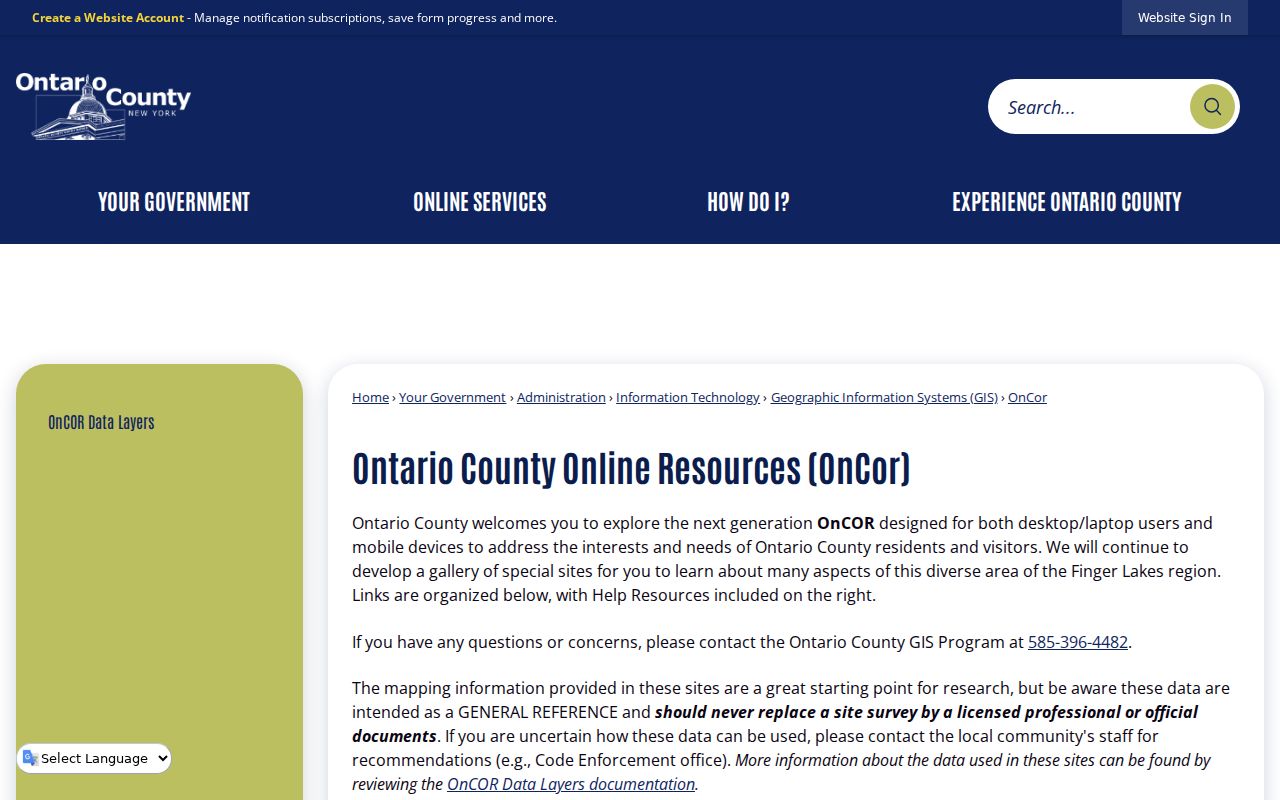
Verify the SWIS and parcel before trusting a same-name or same-street match.
When the Ontario County Owner Field Is Stale
Roll data moves with the calendar. Parcel boundaries freeze near March 1. Tentative roll attributes appear around May. Final rolls land around July. Deeds record all year. The county publishes no official average closing-to-roll lag. Compare the roll date with the newest deed's recording date. A newer grantee is often the stronger present-title lead even while the prior name sits on the annual roll. Index depth matters too: deeds are indexed back to 1951, while images begin in 1973. Use the Clerk's counter or mail route when the confirming image is not online.
LLCs, Trusts, and Estates in Ontario County
Search an LLC or corporation exactly as the deed spells it. Then validate it in the New York Department of State business database. A DBA does not own land. A trustee's name belongs beside the deed's vesting text. Estate transfers may need WebSurrogate or the Ontario Surrogate's Court file. Mailing details help route a letter. They do not prove anyone's residence, so treat them as contact information only. The County Clerk's free Fraud Alert, launched in January 2026, notifies a registrant when a deed or mortgage is recorded under a chosen name. Same-name limits apply. It is a notice service, not a title freeze.
Ontario County Mailing Address Versus Situs
Ontario County records keep two addresses apart. OnCor and the rolls list the parcel's physical situs and the owner's mailing address as separate fields. An out-of-county mailing address fits local ownership fine. The situs itself may have no deliverable mailbox. Never swap the two in a deed search. Match by SBL, municipality, owner name, and deed reference. When a name mismatch appears, test initials, former names, entity suffixes, fiduciary titles, and recording dates; a correction deed, probate transfer, merger, or trust can explain the change. The Clerk index and the full instrument are the verification sources.
When Public Ontario County Portals Are Not Enough
Some questions outrun the portals. An index hit without an image moves to the Clerk counter or the mail-copy route. A pre-digital chain of title lives in historic grantee files, microfilm, RAIMS, and State Archives deed books. Assessment questions go to the municipal assessor. Custom map requests go to county GIS. FOIL covers existing county records not otherwise supplied, but it cannot force an agency to create a new analysis. Stay parcel-focused. Voter lookups and criminal-justice searches prove no ownership. Mailing data proves no residence, and the strongest answer pairs the roll snapshot with the latest recorded grantee under a clearly dated source note.
Ontario County Owner Name Quality Checks
Copy the legal name exactly. Middle initials, trustee capacity, estate wording, and LLC or corporate suffixes all matter. Search reasonable variants next. Never merge same-name people. A true parcel match also needs the municipality, SBL, address, or legal description. When the newest deed uses a different form from the roll, compare dates and look for a correction, merger, probate order, or later conveyance. The state business database checks an entity's spelling. It does not prove the organizer or agent owns the real estate personally, so state conclusions as dated record facts rather than assumptions about control or residence.