
Tracing Former Owners of a Ontario County Property
No single list of former owners exists for Ontario County. The chain has to be rebuilt deed by deed instead. Pull the current deed first and note its grantor. Search that person or entity as a grantee in the next earlier deed, and repeat. Modern index hits lead to images or Clerk copy requests, while older stretches run through posted grantee files, microfilm, deed books, probate, archives, and filed maps.
| Source | Years It Covers | Where Held | What It Shows |
|---|---|---|---|
| IQS deed index | 1951 forward; images from 1973 | County Clerk online | Parties, date, type, reference |
| Historic grantee files | 1789 to 1879 | County website | Buyer index leads |
| Deed books and microfilm | 1789 forward by series | Clerk, RAIMS, State Archives | Full instruments and older chain |
| Probate and directories | Varies by collection | Surrogate, RAIMS, libraries | Authority and address clues |
Pick the index that fits your era. IQS covers deeds indexed from 1951 forward, though images only begin in 1973. For 1789 through 1879, the county's posted grantee indexes point you to buyers. Clerk or archive microfilm carries the grantor side. The decades in between call for direct book and microfilm work at the office.
Walking the Ontario County Deed Chain Backward
Go back one verified transfer at a time. Every deed must tie to the parcel through its legal description, prior reference, municipality, or filed map, never through a shared surname alone, or the Ontario County chain drifts onto someone else's land.
- Find the newest deed with the current owner as grantee.
- Record its grantor, date, deed type, and book/page.
- Search that grantor as a prior grantee and verify the same land.
- Repeat, moving to copies, microfilm, and deed books when web coverage ends.
- Grantor / grantee
- The conveying and receiving parties.
- Chain of title
- The linked sequence of verified transfers.
- Legal description
- The deed language identifying the land conveyed.
How Far Back Ontario County Ownership Records Go
Ontario County deed books reach back to county formation in 1789. A State Archives finding aid covers the books through 1925 on 168 microfilm rolls. County grantee files span 1789 to 1879. How far your search can go also depends on the Pre-emption Line, Connecticut School Fund transactions, county divisions, and the original grants that shaped early landholding here.
Lawful use. Trace prior owners for title, house history, and land research. Do not use historic or current names to target a living person.
Ontario County Backward Deed Timeline
A chain log prevents role reversals and duplicate hits.
| Transfer Date | Grantor to Grantee | Deed Type | Book/Page |
|---|---|---|---|
| Newest recording | Prior owner to roll owner | Read instrument label | Copy exact reference |
| Previous acquisition | Earlier owner to prior owner | Check covenants or fiduciary role | Verify same description |
| Older book era | Grantor index to grantee index | Inspect full deed | Move to microfilm if needed |
- Grantor
- The conveying party.
- Grantee
- The receiving party.
- Chain of title
- The linked sequence of interests and transfers.
- Reverse index
- An index organized from the opposite party role for chain work.
Ontario County's Historic Grantee Index
Buyers from 1789 to 1845 and 1846 to 1879 appear in two posted letter files. Ctrl-F works well for name discovery. The official historic index page explains the split and notes that grantor work and later material require microfilm or an office visit.
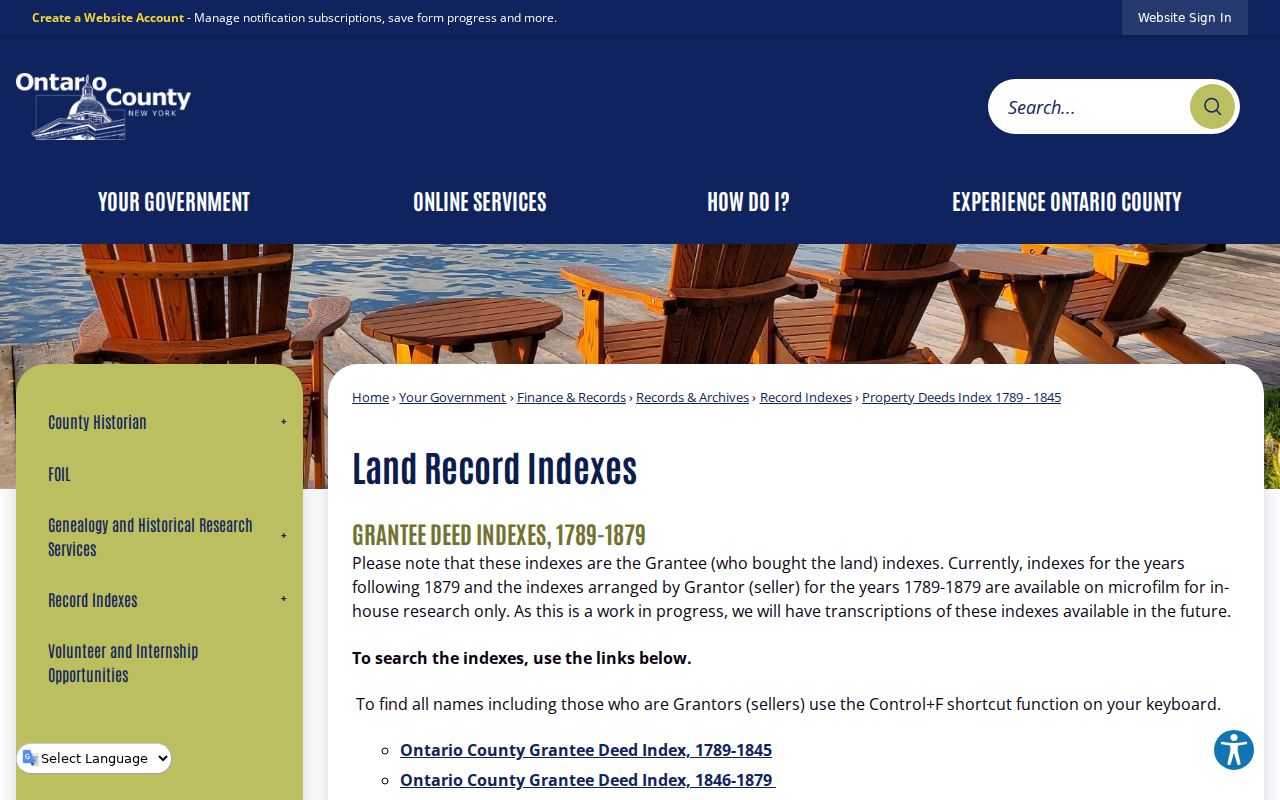
A buyer hit is only a lead to a deed book, not a finished seller-to-buyer chain.
RAIMS and Ontario County Former Owners
RAIMS serves both scheduled visits and remote historical research. Its archive guide, request form, hourly research, and copy charges are spelled out on the RAIMS research page. Court, surrogate, cemetery, and county material there can explain a deed break. The Ontario County Historical Society, Wood Library, and Geneva Public Library add directories, newspapers, photographs, and genealogy resources. Together they often fill gaps the deed books leave open.
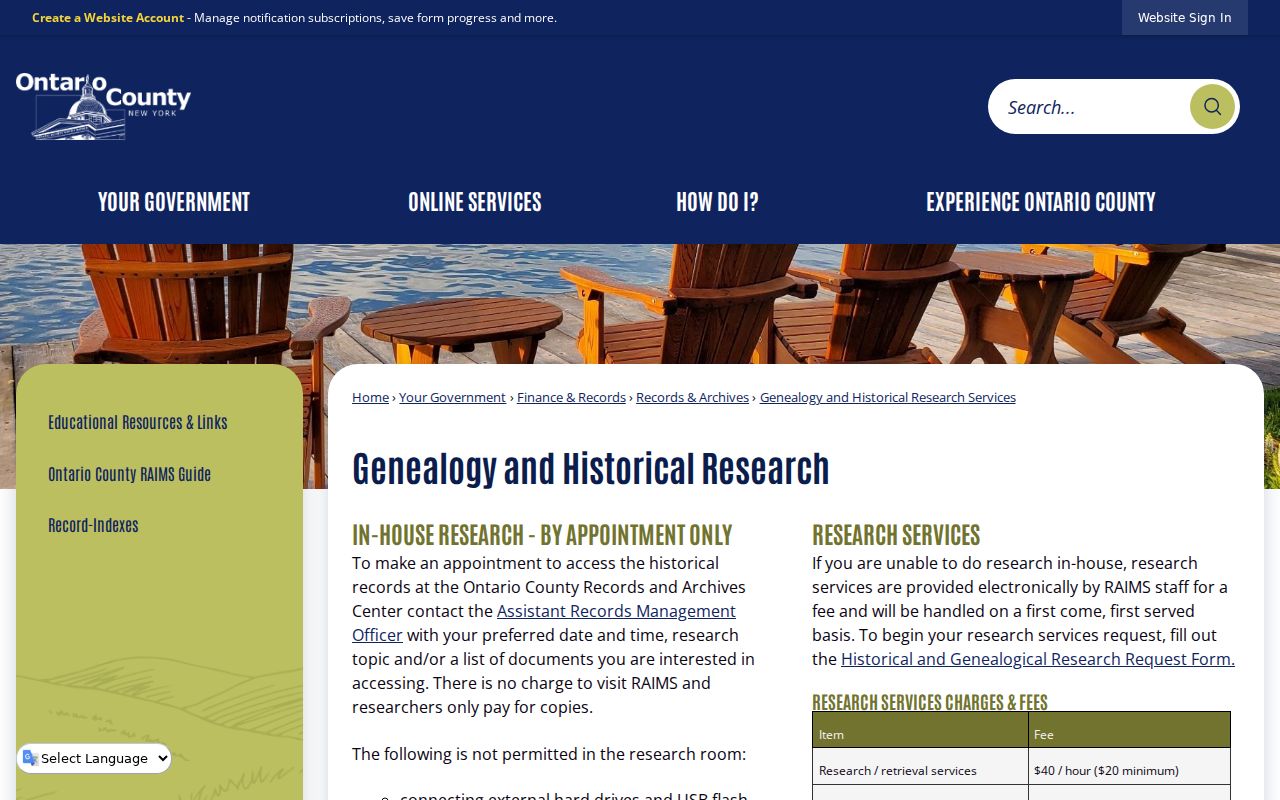
Use an archive finding to locate an instrument or estate file. Then return to the Ontario County deed chain and validate the transfer before trusting it.
Resolve Breaks in an Ontario County Ownership Chain
Breaks in an Ontario County chain usually have an explanation. Probate can change the controlling name without any sale. A parcel split or merge can retire an SBL entirely. Foreclosures, tax proceedings, correction deeds, easements, and entity conversions all introduce unfamiliar parties. Search initials and legal suffixes. Compare descriptions and inspect filed maps when the chain looks wrong. WebSurrogate and the local Surrogate's Court can clarify estate authority.
Local history adds traps of its own. The 1788 Pre-emption Line was resurveyed in 1792. County divisions in 1824 left original Ontario records relevant to successor areas. Connecticut School Fund transactions from 1812 to 1822 may preserve a rare early land trace. Never force those old descriptions onto a modern map without period context.
Where the Online Ontario County Chain Stops
The online Ontario County chain has firm edges. Modern deed indexing begins August 31, 1951. Image availability starts January 2, 1973. An index-only result means you should request a Clerk copy, not assume the deed is missing. Earlier owners require the deed-book and microfilm route, and the State Archives A4593 series lists 168 rolls covering 1789 through 1925.
Record the date and format of each source. Was it an index, an image, a transcription, or an original copy? That distinction keeps the reconstructed chain auditable. It also stops a directory resident, tax-roll owner, or cemetery entry from being mistaken for a recorded titleholder.
Directories and Newspapers as Chain Clues
Directories and newspapers can crack a stalled Ontario County search. Geneva Public Library holds city directories from 1862 through 2000, plus newspapers and photographs. Wood Library adds Canandaigua context. A directory can tie an old street address to a person. A newspaper can explain an estate sale or subdivision. Neither substitutes for a deed. Note the directory year or publication date. Then search that name as grantee or grantor in the matching period. Cemetery and death records can point toward probate. But validate the estate authority and later transfer before adding anyone to the chain.
Ontario County Chain Quality Check
Test every link in the chain. Each transfer needs correct party roles and a recording date. It also needs instrument type, a book/page or document number, and a description reaching the same land. Note whether your evidence is an index, image, copy, transcription, or archive finding. Keep occupancy clues separate from ownership proof. Stop and investigate whenever a parcel splits. Do the same when a legal description shifts unexpectedly, a fiduciary appears, or dates overlap. Guessing is the wrong response. Those signals call for filed maps, probate, foreclosure records, correction instruments, or the parent tract.
Note: A former-owner name belongs in the chain only after a recorded transfer or equivalent title source connects that party to the same land.