
Ontario County Deed Records and What They Show
The Ontario County Clerk records conveyances for property records across the county. The office also handles related land instruments. A deed proves that an instrument was recorded. It names the parties, gives the date and recording reference, and carries the property language. Ontario County records do not treat a recorded deed as a guarantee of clear title, though. Warranty, bargain-and-sale, quitclaim, executor, and correction deeds all appear in the deed records. Each type carries different promises about the property transferred.
| Deed Type | What It Does | Common Use |
|---|---|---|
| Warranty deed | Conveyance with stated title covenants | Read reservations and prior references |
| Quitclaim deed | Transfer of whatever interest is held | Examine the underlying chain |
| Bargain-and-sale deed | Common New York conveyance form | Read covenant language in the instrument |
| Trustee / executor deed | Fiduciary transfer | Check trust or probate authority |
| Correction deed | Repairs a prior instrument | Read both recordings |
The label narrows a property search, but the recorded wording controls what was conveyed and under what authority in Ontario County deed records.
Search the Ontario County Grantor-Grantee Index
The Clerk's index for Ontario County deed records can be searched by party, grantor, grantee, book and page, document number, type, phrase, town, and recorded date. Start with the exact tax roll owner or a known deed reference. To build a chain, find the newest grantee and read that deed for the grantor. Then search that grantor as a prior grantee. Repeat the walk backward while logging instrument type and book/page with dates. Keep the Ontario County parcel number close at hand.
- Find the newest matching deed with the current owner as grantee.
- Read its grantor, description, date, and prior reference.
- Search that grantor as an earlier grantee.
- Repeat and document each verified transfer.
- Grantor
- The party conveying the interest.
- Grantee
- The party receiving the interest.
- Chain of title
- The linked sequence of recorded interests affecting the land.
- Book/Page vs Instrument Number
- Both are index references that should be copied exactly and tied to a recording date.
Getting a Copy of a Ontario County Deed
Use an available IQS image for working deed records research. When no image exists, turn to the Ontario County Clerk's counter. Certification is also available through its documented mail-copy process. The office sits at 20 Ontario Street in Canandaigua, and its main number is 585-396-4200. For historical deed records, RAIMS offers scheduled and remote research paths. State Archives microfilm and local history collections can also bridge gaps in Ontario County property records.
Recorded, not guaranteed. The index reports filed instruments. It is not a title opinion, and unrecorded interests or exceptions may require professional examination.
Ontario County Deed Types at a Glance
Instrument labels help sort Ontario County deed records results. But the document itself controls the parcel transfer. A correction deed may repair a prior description or party error. An executor or administrator deed points toward an estate file. A quitclaim transfers whatever interest the grantor holds, without the covenants a warranty form carries. A mortgage is financing, not a conveyance of the ownership interest a property search targets.
| Instrument | Likely Use | Next Check |
|---|---|---|
| Warranty or bargain-and-sale deed | Ordinary conveyance with stated covenants | Grantee, legal description, prior reference |
| Quitclaim deed | Transfer of an existing interest | Underlying chain and related parties |
| Executor or administrator deed | Estate-related sale or transfer | WebSurrogate and Surrogate's Court file |
| Correction deed | Repair of an earlier recorded instrument | Both the corrected and original deed |
Ontario County's 1951 and 1973 Deed Cutoffs
Official IQS help distinguishes index depth from image depth in Ontario County deed records. Deed indexing reaches back to August 31, 1951. Online deed images begin January 2, 1973. A result falling between those dates can still be a sound index lead even when no scan opens, so treat it as a pointer to the Clerk's copy channels. Other categories carry their own date ranges for mortgages, liens, lis pendens, maps, UCCs, DBAs, and court indexes. The official coverage page displays those category differences for Ontario County.
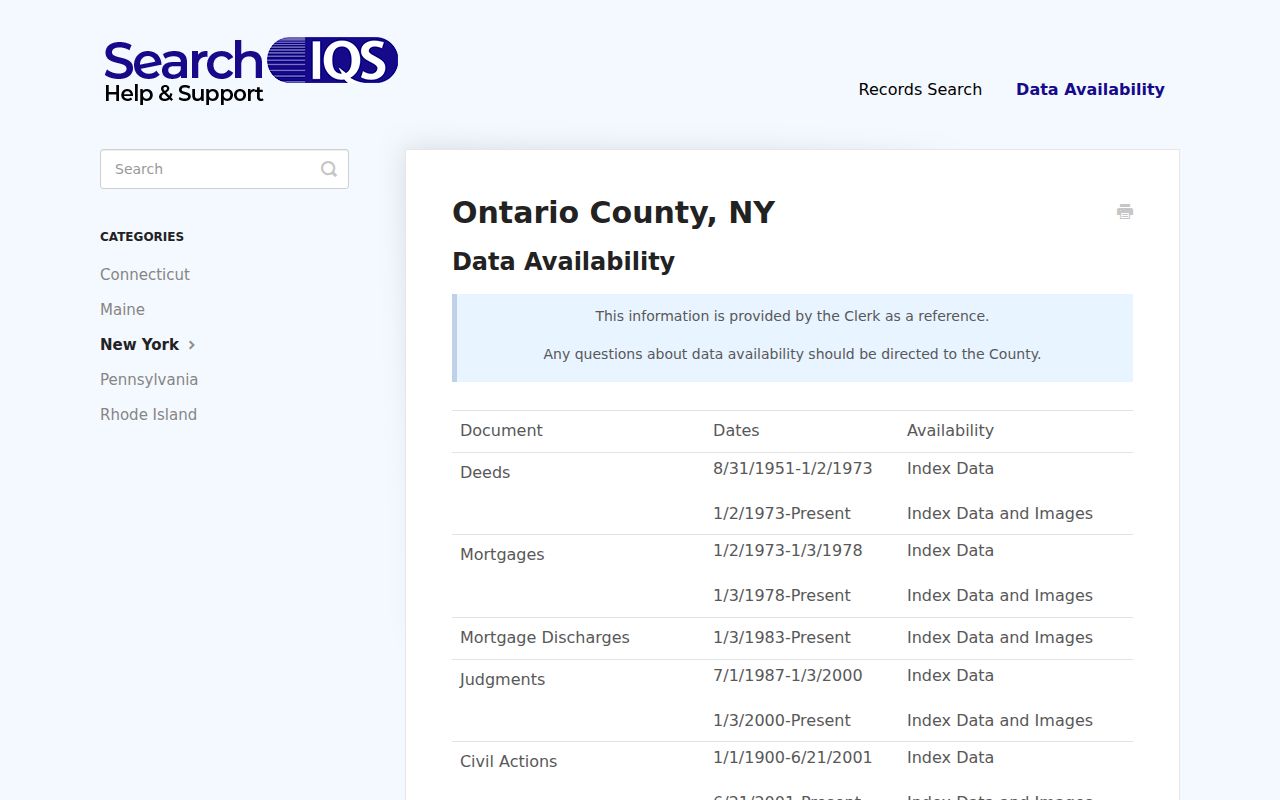
The image confirms why an index-only result must move to the Clerk's copy channels rather than be discarded in an Ontario County deed records search.
Use the Ontario County Advanced Deed Search
The county-branded interface for Ontario County deed records offers separate grantor and grantee roles. It also includes book/page, document number, document type, phrase, town, and date filters. Use role searches for a chain and direct identifiers for a known instrument. OCR text can broaden discovery. Indexed party fields remain the stronger route for names in an Ontario County property search. The advanced County Clerk search shows the available controls.
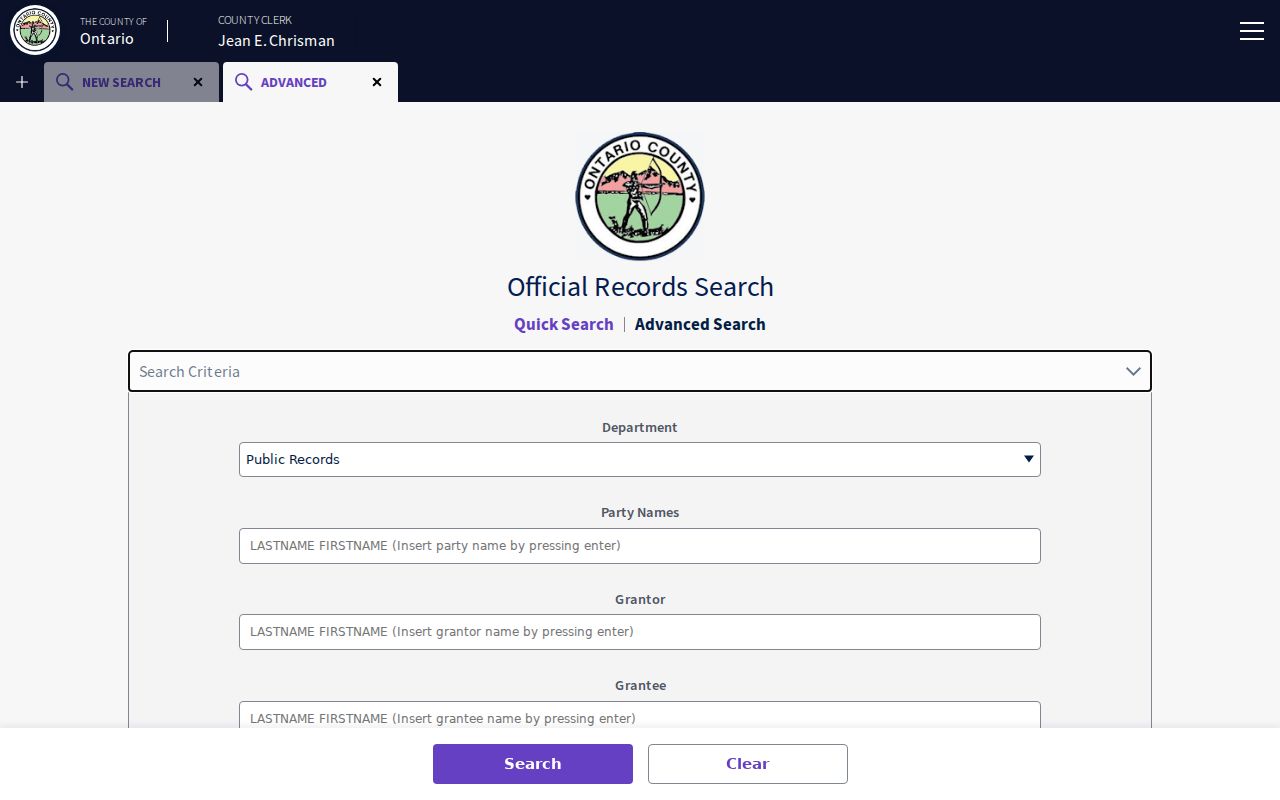
Copy the result reference into the parcel notes so the deed records and assessment layers stay connected in an Ontario County property search.
Historic Ontario County Deed Books
Early Ontario County ownership appears in posted grantee indexes. These cover 1789 to 1845 and 1846 to 1879. These are buyer indexes. They do not replace the grantor side of a full deed records chain. The Ontario County Clerk points researchers to microfilm or in-house sources. Those cover the missing seller route and later material. The State Archives finding aid lists Ontario County deed books from 1789 to 1925. The collection spans 168 microfilm rolls. The historic grantee-index page explains the letter files and microfilm limitation for each parcel researcher.
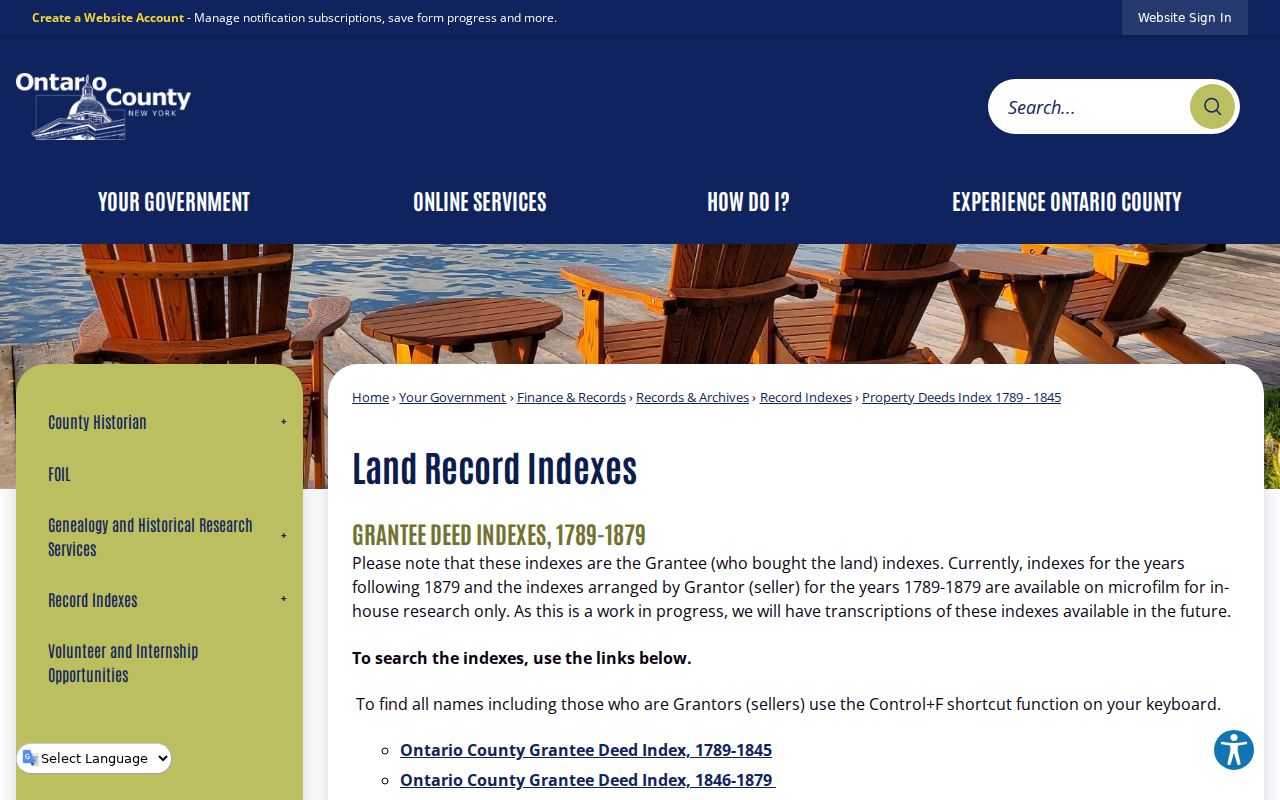
Search a buyer by letter in Ontario County deed records. Then validate the hit in the deed book and rebuild the seller side through microfilm.
Maps, Estates, and Breaks in an Ontario County Chain
A parcel split or merger can change an SBL. The land stays traceable through its legal description. A filed plat or subdivision map can connect new lots to a parent tract. Probate explains why an owner name changes without a conventional sale. Ontario Surrogate's Court and WebSurrogate may supply a file number, will, letters, or decree lead for the deed records chain. Foreclosure, tax enforcement, easements, and correction instruments also interrupt a simple buyer-seller pattern in the Ontario County tax roll and property records. Historic descriptions demand extra care. The 1788 Pre-emption Line was resurveyed in 1792. Later county divisions left Ontario-origin deed records relevant to land now elsewhere. Preserve the deed's original calls. Use a surveyor for boundary interpretation of any Ontario County parcel.
Ontario County Deed Filing and Copy Context
County guidance covers transfer forms, recording charges, and transfer-tax handling. Correction deeds for Ontario County deed records are covered too. Filing does not convert the Clerk into a title adviser. Before following later instruments, preserve names, acknowledgments, and conveyance language. Also keep reservations, easements, legal descriptions, and prior references from each deed.
Distinguish a portal image from a certified copy. The first supports property search work. The second is requested for an official purpose. The current Clerk fee schedule controls charges. A mail request should state the parties, record type, date, and book/page or instrument number. RAIMS research and archive copies of Ontario County deed records follow separate published rules.
Ontario County Deed Fraud Alert
Ontario County launched a free Fraud Alert. The service went live in January 2026 and costs nothing. Register a name, and it sends notice. A deed or mortgage recorded under that name triggers the alert.
It has limits. The alert does not verify identity. It does not block a filing. It also does not separate people who share a name. Check a notice against the instrument number, the property description, and the known parcel before contacting the Clerk. A new deed can appear before the next annual roll names the grantee.
Ontario County Encumbrances Beside a Deed
A deed rarely tells the whole story. Ontario County Clerk files also hold mortgages, liens, judgments, lis pendens, easements, and filed maps. These can shape a conveyance. Search the relevant Clerk category under the exact parties and dates. The deed index alone will not surface every encumbrance. Category coverage dates differ from deed coverage.
Tie every release to its instrument. A satisfaction or release should connect back to the original filing it clears. A court filing may explain foreclosure or quiet-title activity. A UCC filing may concern business collateral rather than the real estate itself. A professional title search is needed. It determines which recorded and unrecorded interests affect a current transaction.
Note: Copy the document reference exactly before leaving the index; party names alone are not enough to distinguish similar Ontario County deed records.
A good deed note tells you where it stands. It should say whether the full instrument image came from the Clerk, was ordered as a copy, or remains an index-only lead.