
The Values on a Ontario County Property Record
A single Ontario County parcel record can carry a land assessment, a total assessment, taxable values, a computed full-market figure, and a sale date or price from a recorded deed. Each number answers a different question. Assessment supports the tax roll. Taxable value reflects whatever exemptions apply. Full-market value follows the municipality's stated level of assessment, while recorded consideration belongs to one particular transfer, not to the property's worth today.
| Value | What It Is | Where |
|---|---|---|
| Assessed value | Tax-roll value before exemption deductions | Final roll and OnCor |
| Full-market value | Assessment adjusted by municipal level | Final roll |
| Last sale price | Consideration tied to a recorded transfer | Deed and transfer documents |
| Land vs improvement | Components of total assessment | Parcel Detail report |
New York ties assessment to market value through a municipal level, sometimes called a uniform percent. Canandaigua's 2025 roll states 100 percent. Geneva's states 92 percent. The resulting full-market figure is a calculation, not a promise about what an open-market sale would bring, and it should never be called an appraisal.
Looking Up a Ontario County Property Value
Look up the address in OnCor and confirm the right municipality and SBL before opening the dated parcel or roll report. Read each column separately: land, total, exemption, taxable, and full-market. When a recorded consideration figure matters, the Clerk's deed and transfer record is the source to use.
- Search OnCor by address and verify SWIS and SBL.
- Open the correct roll year and read land and total assessment.
- Note exemptions and each jurisdiction's taxable value.
- Check the recorded deed and sale date for transfer context.
- Assessed value
- The figure placed on the tax roll.
- Market or appraised value
- A value opinion for a stated date and purpose.
- Level of assessment
- The municipal ratio used to relate assessment to full-market value.
What a Ontario County Assessor Value Is Not
The assessor values parcels with mass-appraisal methods built for the tax roll. A parcel-specific appraisal works from a defined valuation date and purpose. A sale price reflects one transaction between two parties. Roll dates, physical changes, exemptions, and differing municipal assessment levels can all push these figures apart. They rarely match by accident.
Value versus price. An Ontario County assessed value is for tax administration, not a forecast of sale proceeds. Obtain a qualified appraisal for a current market opinion.
Compare Ontario County Property Value Types
Label every value with its source and date.
| Value Type | What It Means | Where It Is Recorded |
|---|---|---|
| Assessed value | Municipal roll value before exemption deductions | Assessment roll and OnCor |
| Taxable value | Assessment remaining for a specific jurisdiction | Roll exemption and taxable columns |
| Full-market value | Assessment adjusted by the stated level of assessment | Municipal roll |
| Last sale or consideration | Amount tied to a particular recorded transfer | Deed and transfer documents |
Find Ontario County Assessed Value in OnCor
OnCor connects the parcel map with land and total assessment, property class, owner of record, deed reference, and printable reports. Parcel Detail goes further, exposing assessment history and improvement information for the parcel. The official OnCor application page is the county's starting point.
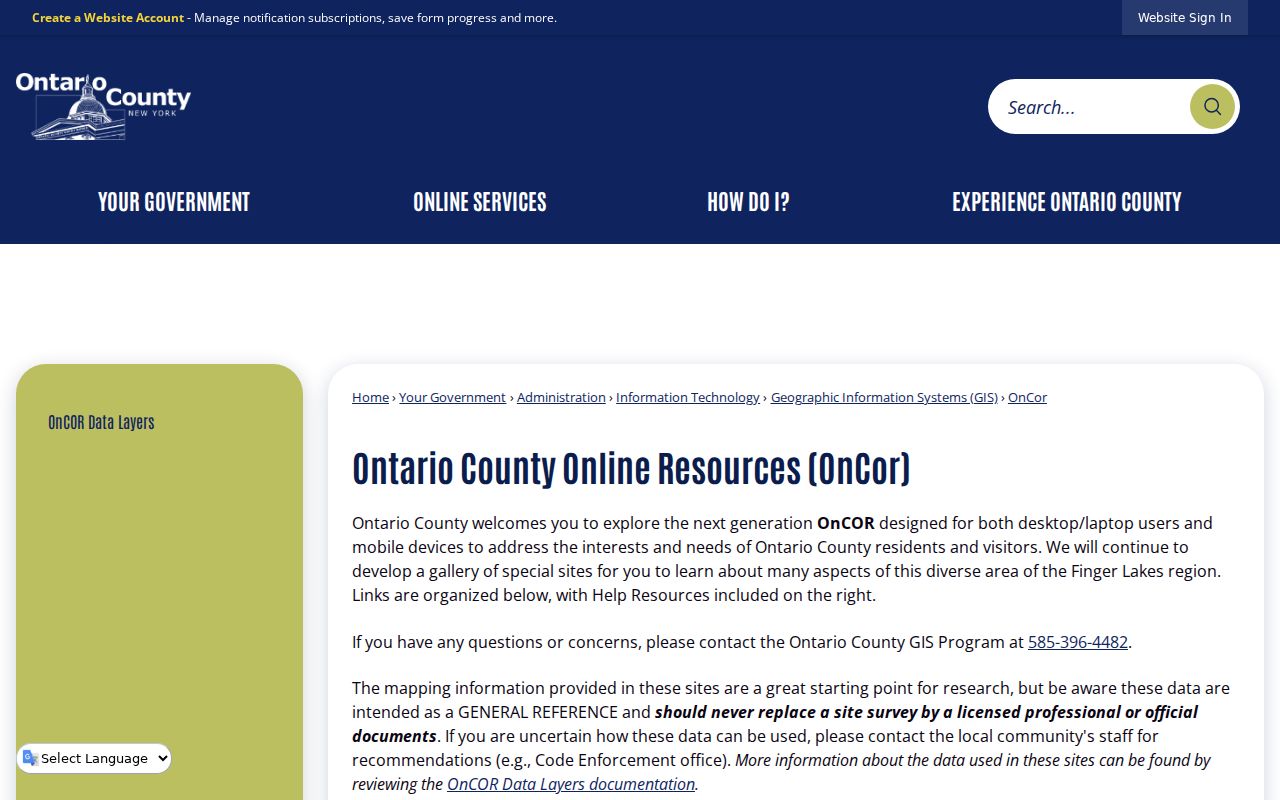
Match the municipality and SBL first, then compare the displayed value against a roll or deed record.
Canandaigua and Geneva Value Ratios
Canandaigua's 2025 final roll uses a 100.00 percent uniform percent. Assessed and computed full-market figures can align where no other adjustment intervenes. Geneva's 2025 roll uses 92.00 percent. Full-market value is derived from assessment at that stated level. New York ORPTS describes the general relationship in simple terms: full-market value equals assessed value divided by the level of assessment.
None of this predicts a sale. The 2026 city and town tax-base-growth factor of 1.0000 for both cities is not house-price appreciation either. It serves a tax-base calculation. That figure belongs in that context alone.
Exemptions Change Ontario County Taxable Value
Exemptions reduce taxable value differently for county, city or town, and school purposes. Geneva's sample entries make the point clearly. One parcel shows county and city taxable values of $138,800. Its school taxable value is $52,700 under Enhanced STAR. Veteran and aged exemptions can create other splits. The accurate statement names the exemption, the jurisdiction, the roll year, and the exact column.
Bill amounts, due dates, collection, and grievance mechanics belong to the tax record. They are not part of the value definition.
Ontario County Value Dates and Sale Evidence
Ontario County's calendar sets the rhythm. Parcel boundaries freeze near March 1. Tentative attributes appear around May 1. Final rolls arrive around July 1. A deed can record at any point in the year, so sale information and roll ownership may not share an effective date. Record the recording date, valuation date, taxable-status date, and roll year together so the evidence stays coherent.
The live parcel schema includes a SALE_DATE field and deed references, though the county does not publish a live consideration display for every parcel. When price matters, inspect the deed and transfer documents rather than deriving a number from assessment. A deed answers transfer questions. A survey answers boundary questions. An appraisal answers a current market-value question.
Land, Improvements, and Ontario County Value History
OnCor Parcel Detail separates land from total assessment. It describes improvements. It also provides assessment history over time. A rising total assessment can reflect a revaluation or new construction. It can also reflect corrected inventory or market movement inside the mass-appraisal model. Attributing the change to one cause without the assessor's record is guesswork. Permit files add context for known work. Even so, a submitted permit does not prove completion or its exact contribution to value. Compare dated roll fields, improvement data, and assessor notes before describing any change.
Use the Right Ontario County Valuation Evidence
Each piece of Ontario County valuation evidence has its own job. A deed records a transfer and may carry consideration. The roll supplies tax assessment and calculated full-market fields. A tax bill applies rates to taxable values. A survey addresses land geometry. A qualified appraisal estimates value for a defined date and purpose. None can be silently substituted for another.
For an appeal, preserve the tentative roll and supporting evidence under the municipal calendar. For a sale decision, obtain market analysis or an appraisal. For historical research, treat the value as a dated roll fact and avoid translating it into a modern price without a separate method.
Note: Always pair an Ontario County property value with its source, effective date, municipality, and whether exemptions have already reduced the displayed figure.